

June 27th, 2024
"*" indicates required fields
Are you thinking about getting solar panels on your home but want to know the pros and cons more clearly? You’re in the right place.
Solar panel installations are a great investment for many households in the UK. However, they come with some important considerations to keep in mind.
In this Grant Store blog post, we’ll explore the benefits and drawbacks of solar panels to help you see if it’s worth your time, money, and effort.
This guide covers:
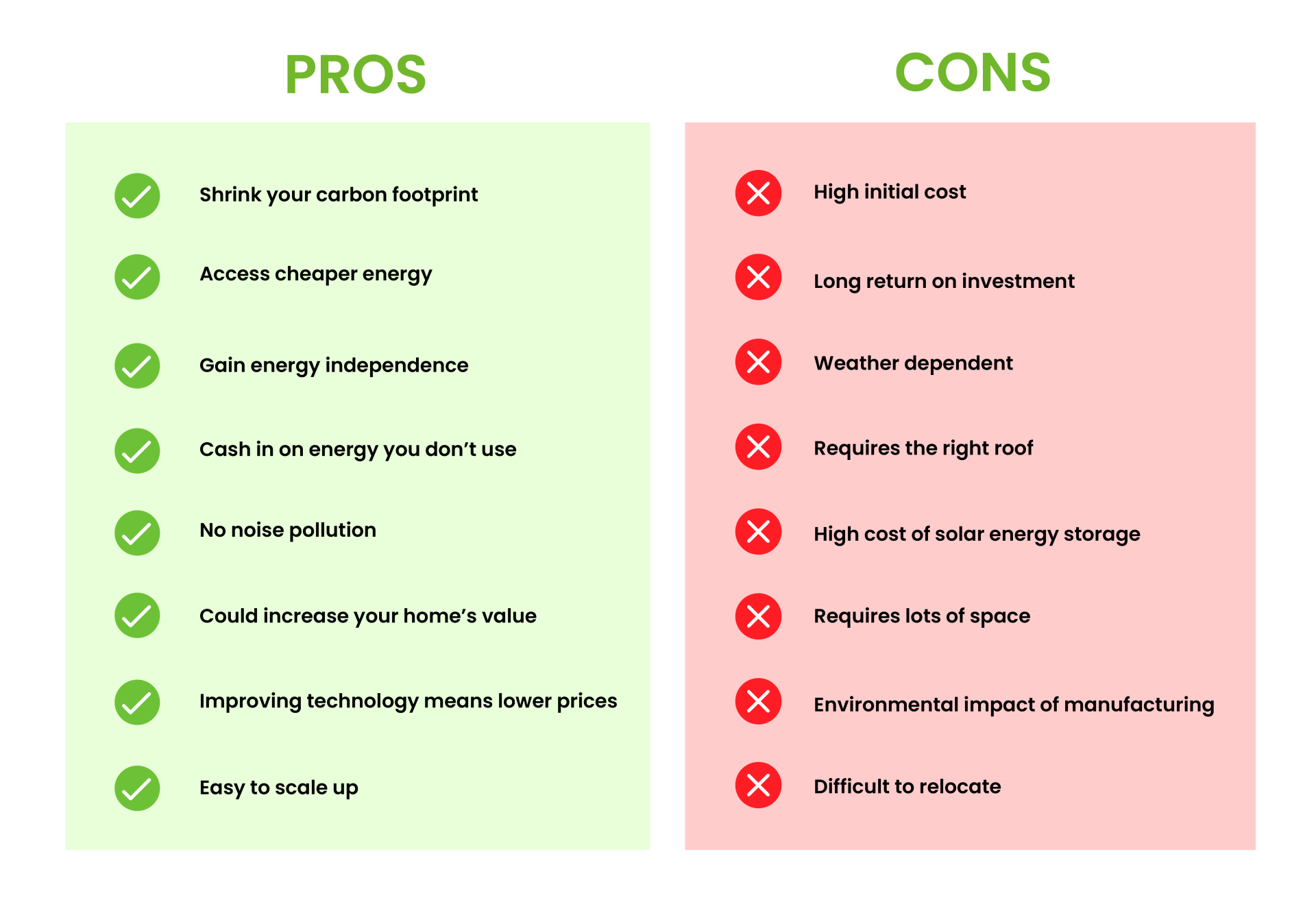
Let’s start with the advantages of solar panels, shall we? As one of the leading solar panel installers in the UK, we believe there’s a lot to say about them.
In addition to their sustainability factor, solar panel installations can also offer major cost savings on electricity bills.
But how?
Our homes tend to rely solely on electricity from the grid, which is connected to non-renewable energy sources like coal power plants.
But with solar panels, you have your own mini power plant on your roof, capturing and converting daylight into electricity, which powers your home with clean, sustainable energy.
With all this electricity being converted from daylight, you can reduce your reliance on the grid and your monthly energy bills!
This is especially helpful because traditional grid-supplied electricity is known to increase steadily over time. By generating your own self-sufficient solar energy, you’re not tied down to these unpredictable, increasing costs.
Are you interested in how much you could save with solar panel installation?
Our handy solar panel calculator can help you see the potential savings for yourself.
Another big benefit of solar energy is the fact that it is fully renewable and lowers your dependence on traditional fossil fuels.
A 2023 survey from the Department of Business, Energy, and Industrial Strategy (BEIS) found that over 80% of respondents were worried about climate change. With such a high number concerned for the planet’s future health, it’s clear that a solution needs to be found. Solar panels can be a big part of this, helping lower the dependence on non-renewable fossil fuels that cause the most damage.
The financial benefits of solar panels don’t end there. Did you know you could turn your solar system into a money-maker by selling excess electricity back to the grid?
The Smart Export Guarantee (SEG) was launched in 2020 and allows solar users to find the best rate for their excess electricity.
Your supplier will track your electricity exports through your smart meter and pay you according to their tariff—usually quarterly or annually.
Finally, solar panels can even increase the future value of your home. Since future buyers will be looking for ways to reduce their ongoing expenses, a home with solar panels that generate clean, free energy will put a premium on your home.
As you can see, there are plenty of reasons why a solar panel installation might be great for your wallet and the planet, but there are also some potential things to consider before investing.
In addition to the cost of the solar panels, you need an inverter to generate electricity and mounting equipment to secure the panels to your roof.
If you want to maximise your solar energy, you might even want additional battery storage for use off-grid, which can lead to a high upfront cost.
Fortunately, plenty of government grants, funding, and tax breaks for homeowners make solar panels cheaper and more financially accessible than ever, including the ECO4 grant scheme.
Explore the range of incentives and solar funding options with Grant Store here.
Solar panels are a great way to save money on your electricity bills, but depending on your rates, roof size, exposure to sunlight, and panel efficiency, the time it takes to see this return on investment can be several years.
This might not be ideal for homeowners who don’t plan on staying in their homes for the long term, though it’s possible that solar panels can improve a property’s perceived value, helping finalise a future sale more quickly.
We know – there’s a lot to consider, so don’t worry if you’re overwhelmed. If you’re considering installing solar panels for your home and think you could be eligible for funding but don’t know where to look first, we’ve got you covered.
Get in touch today, and we’ll let you know if solar energy is the best option for your home. If not, let’s see what other clean home heating options are available to you—we’ll even apply for and handle the full installation if you find your perfect solution.
June 27th, 2024

June 27th, 2024

June 11th, 2024
June 11th, 2024

June 11th, 2024
June 11th, 2024
June 1st, 2024
May 22nd, 2024

April 25th, 2024